Laravel Handbook — System Setup & Architecture Timeline

1. Project Initialization
1.1 Environment Setup
Core Requirements
- PHP (version depends on your Laravel release — typically PHP 8+).
- Required extensions:
openssl,mbstring,pdo,tokenizer,xml,ctype,json,bcmath,curl. - Composer (dependency manager).
- Node.js + npm/pnpm/yarn (for asset bundlers like Vite).
Optional Dev Tools
-
Laravel Installer:
composer global require laravel/installer -
Laravel Valet (macOS), Homestead (Vagrant), Docker/Sail (cross-platform).
-
Database engines: MySQL/MariaDB, PostgreSQL, SQLite, SQL Server.
1.2 Creating a New Laravel Project
Using Composer
composer create-project laravel/laravel my-app
Using Laravel Installer
laravel new my-app
Using Laravel Sail for Containerized Setup
curl -s "https://laravel.build/my-app" | bash
cd my-app
./vendor/bin/sail up
1.3 Initial Directory Structure
| Path | Purpose |
|---|---|
app/ | Core application code |
app/Http/ | Controllers, Middleware |
app/Models/ | Eloquent models |
bootstrap/ | Framework bootstrap logic |
config/ | All config files |
database/ | Migrations, seeders, factories |
public/ | Web server entrypoint |
resources/ | Blade views, JS/CSS |
routes/ | Route definitions |
storage/ | Logs, cached data |
vendor/ | Composer dependencies |
1.4 Autoloading & Bootstrapping
Autoloading
- Composer autoload defined in
composer.json. - PSR-4 mapping:
"App\\": "app/"
Entry Point
-
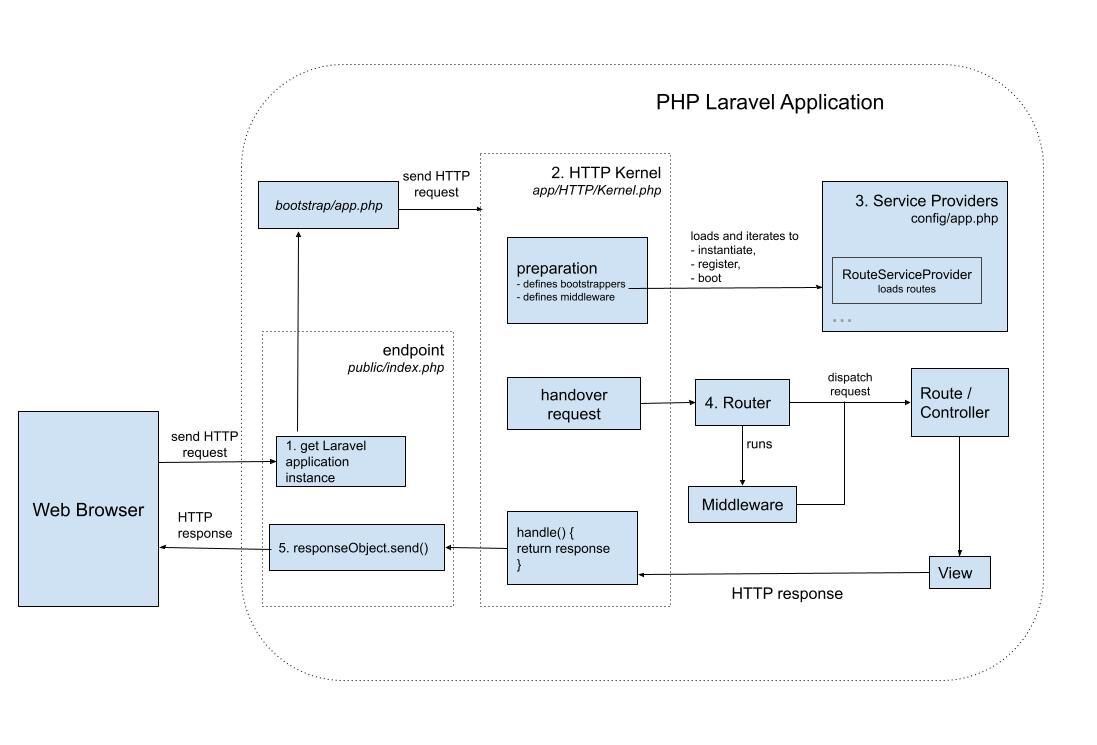
All HTTP requests land at:
public/index.php
Bootstrapping Steps
- Load Composer autoload.
- Boot the application (
bootstrap/app.php). - Resolve HTTP Kernel.
- Send request through middleware.
- Dispatch route.
- Return response.
2. Laravel Application Architecture

2.1 MVC Structure
Model
- Eloquent ORM models representing DB tables.
- Handles business logic & relationships.
View
- Blade templates in
resources/views.
Controller
- Accepts requests, calls services/models, returns responses.
2.2 Service Container
Purpose
- Dependency injection engine.
- Manages class resolution & bindings.
Binding Example
app()->bind(
    App\Contracts\Uploader::class,
    App\Services\S3Uploader::class
);
Resolving
$uploader = app(App\Contracts\Uploader::class);
2.3 Service Providers
Roles
- Register services, event listeners, middleware.
- Configure package services.
Lifecycle
- Registered in
config/app.php. register()→ bindingsboot()→ logic after registration
2.4 Facades
Purpose
- Static interface → underlying service container objects.
Example
Cache::put('key', 'value', 3600);
Behind the scenes
- Facade resolves real class via container binding.
2.5 Application Lifecycle (Deep Dive)
- Request hits
public/index.php - Application bootstrapped
- Kernel resolves middleware stack
- Router examines URL/method
- Controller executes
- Response generated and returned
- Kernel terminates (closing tasks)
3. Database Layer


3.1 Environment & Config
.env
DB_CONNECTION=mysql
DB_HOST=127.0.0.1
DB_DATABASE=appdb
DB_USERNAME=root
DB_PASSWORD=password
config/database.php
- Maps drivers → PDO
- Customize connections, replication, Redis, options
3.2 Migrations
Create Migration
php artisan make:migration create_users_table
Running
php artisan migrate
php artisan migrate:rollback
Structure Example
Schema::create('users', function (Blueprint $table) {
    $table->id();
    $table->string('name');
    $table->timestamps();
});
3.3 Seeders & Factories
Seeder
php artisan make:seeder UserSeeder
Factory
User::factory()->count(10)->create();
3.4 Query Builder
$users = DB::table('users')
    ->where('active', true)
    ->orderBy('id')
    ->get();
3.5 Eloquent ORM
Basic Model
class User extends Model {
    protected $fillable = ['name', 'email'];
}
Relationships
public function posts() {
    return $this->hasMany(Post::class);
}
Accessors/Mutators
protected function name(): Attribute {
    return Attribute::make(
        get: fn ($value) => ucfirst($value),
        set: fn ($value) => strtolower($value)
    );
}
4. Request → Response Lifecycle

4.1 HTTP Kernel
Located at:
app/Http/Kernel.php
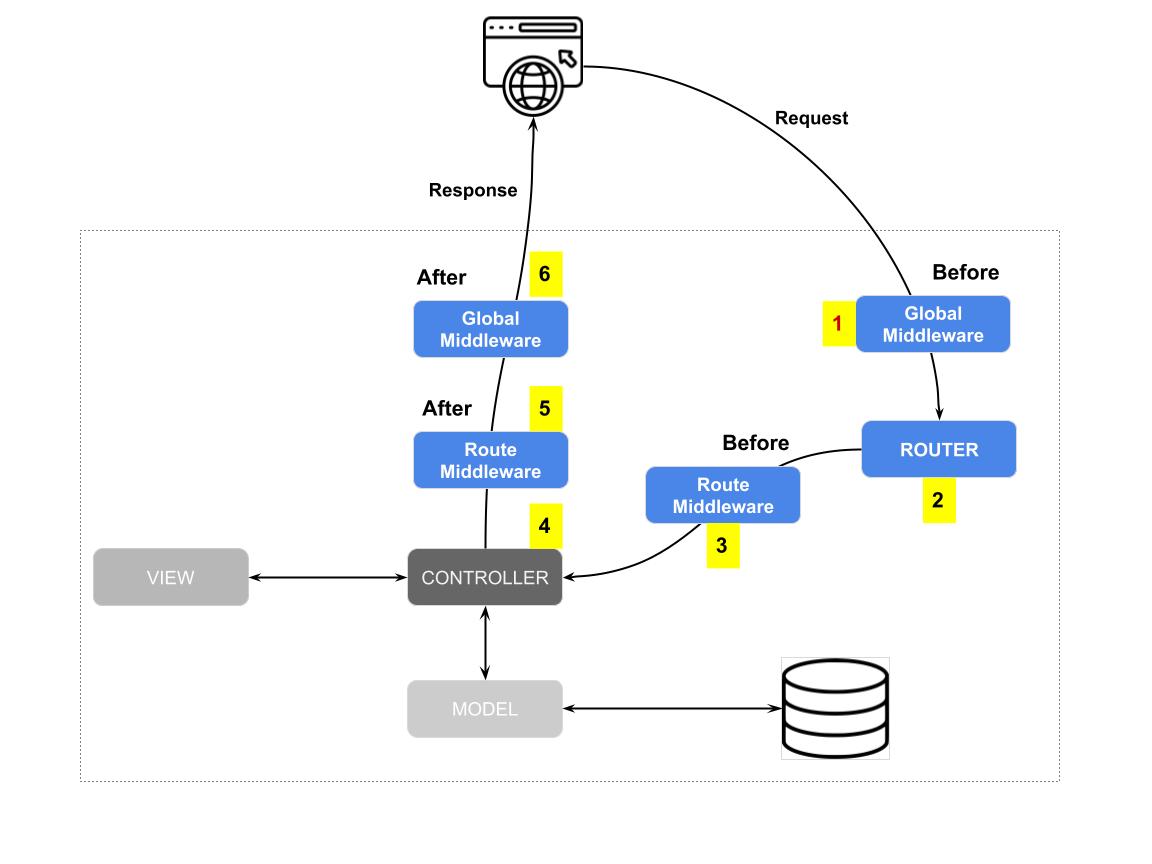
Types of Middleware
- Global
- Route group (e.g.,
web,api) - Route-specific
4.2 Middleware Pipeline
Creating Middleware
php artisan make:middleware EnsureRole
Usage
Route::get('/admin', AdminController::class)
    ->middleware('role:admin');
4.3 Routing
Web
Route::get('/', HomeController::class);
API
Route::middleware('auth:sanctum')->get('/me', fn() => auth()->user());
Route Model Binding
Route::get('/users/{user}', fn(User $user) => $user);
4.4 Controllers
Define
php artisan make:controller UserController
Usage
class UserController {
    public function index() {
        return User::all();
    }
}
4.5 Response Types
- String
- JSON (
return response()->json([...])) - View
- Stream
- File/download
- Custom response macro
4.6 Exception Handling
Located at:
app/Exceptions/Handler.php
Supports:
- Custom render logic
- Report filtering
- Override exception types
- API error formatting
5. Logging
5.1 Log Configuration
config/logging.php
Channels include:
singledailystackslackpapertrail- Custom Monolog handlers
5.2 Logging Usage
Log::info('User logged in', ['user_id' => $user->id]);
Log::error('Payment failed', compact('order'));
Contextual Logging
Log::withContext(['request_id' => Str::uuid()]);
6. Authentication & Authorization
6.1 Guards
Types
session(web)tokensanctumpassport(OAuth2)
Configuration
config/auth.php
6.2 User Providers
- Eloquent (default)
- Database (query builder)
6.3 Authentication Starter Kits
Breeze
- Simple, lightweight scaffolding.
Jetstream
- Teams, sessions, API tokens, optional Livewire/Inertia.
Sanctum
- SPA tokens, mobile tokens, simple API auth.
Passport
- Enterprise OAuth2 server.
6.4 Gates
Gate::define('edit-post', function ($user, Post $post) {
    return $user->id === $post->user_id;
});
6.5 Policies
php artisan make:policy PostPolicy --model=Post
7. Additional Core Components
7.1 Queues
Creating Jobs
php artisan make:job SendInvoiceEmail
Dispatching
SendInvoiceEmail::dispatch($order);
Workers
php artisan queue:work
7.2 Events & Listeners
Create
php artisan make:event OrderPaid
php artisan make:listener SendReceipt
Dispatching
event(new OrderPaid($order));
7.3 Scheduler
Define Tasks
In:
app/Console/Kernel.php
$schedule->command('orders:cleanup')->daily();
CRON single entry
* * * * * php /path/artisan schedule:run
7.4 Caching
Basic
Cache::put('key', 'value', 3600);
Remember
Cache::remember('products', 3600, fn() => Product::all());
Drivers
- file
- redis
- memcached
- database
8. Testing
8.1 Feature Tests
php artisan make:test LoginTest
public function test_login() {
    $this->post('/login', ['email' => 'test@example.com'])
         ->assertRedirect('/dashboard');
}
8.2 Unit Tests
public function test_sum() {
    $this->assertEquals(4, sum(2,2));
}
8.3 HTTP Tests
Laravel provides helpers:
$this->get('/api/users')->assertJsonCount(5);
9. DevOps, Deployment & Optimization
9.1 Environment Separation
-
.env.local,.env.production -
Config caching:
php artisan config:cache
php artisan route:cache
php artisan view:cache
9.2 Deployment Pipeline
- Pull code
- Install dependencies
composer install --no-dev --optimize-autoloader - Run migrations
- Cache configs/routes/views
- Restart queue workers
9.3 Optimization Commands
php artisan optimize
php artisan cache:clear
10. Appendix
Artisan Cheat Sheet
| Command | Purpose |
|---|---|
make:model | Create model |
make:controller | Create controller |
make:migration | Create migration |
migrate | Run migrations |
serve | Dev server |
queue:work | Run queue worker |
route:list | Display routes |